Reading SMILE LASIK Specs: The Lasers and Diagnostics Listed by a Gangnam Eye Clinic
SMILE LASIK marketing tends to lead with a laser brand, an incision size and a surgery time. Those are spec-sheet items, and they can be read the way you would read any device listing: what the platform is, what each number measures, and which lines are measurable specifications rather than the clinic's own claims. EYEONCE Eye Clinic Gangnam (아이원스안과) publishes an unusually detailed equipment page, so its listings make a useful worked example.
SMILE, SMILE Pro, SMILE LASIK: which name refers to what?
The naming is the first thing to untangle. KCODI's overview defines SMILE as the procedure and SMILE Pro as the newer, faster laser platform that performs it, and notes that SMILE LASIK is a popular search phrase even though SMILE is technically not LASIK, because no flap is made.
EYEONCE uses the names differently. Its equipment page lists SMILE PRO and SMILE LASIK as two procedures, both performed on the Ziemer FEMTO Z8 femtosecond laser. So on this clinic's pages, SMILE PRO is a procedure label on a Ziemer laser, not a separate platform. When two sources use the same word for different things, the safest question is the literal one: which laser, by manufacturer and model, will treat my eyes?
What does the equipment page list?
Femtosecond laser. The Ziemer FEMTO Z8 is the flagship laser for both SMILE procedures, and the page says the same platform also does precision work for LASIK flap creation and cataract surgery. The SMILE LASIK page names it as the Ziemer FEMTO LDV Z8 and describes high-rate, low-energy delivery with real-time OCT scanning, at about 10–15 minutes for both eyes.
How it works, in the clinic's own steps: a lenticule is created inside the cornea, then removed through a small-incision extraction. The stated incision is a 2–4 mm keyhole, with no flap.
Excimer laser. A second, separate system, the WaveLight EX500, is listed as a high-speed excimer laser with eye-tracking for all-laser LASIK, LASEK and surface ablation. It is not the laser used for SMILE.
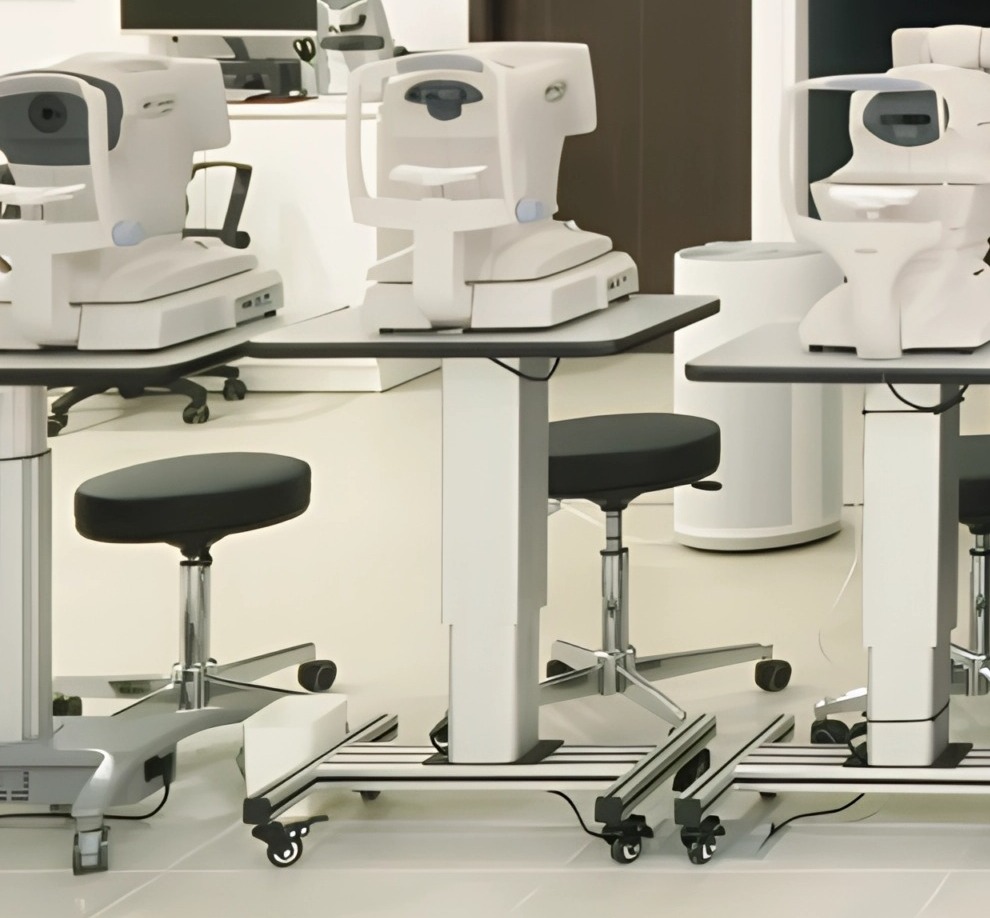
Diagnostics. Topcon stations are listed for corneal topography, pachymetry (corneal thickness), OCT scanning, and automated refraction and keratometry. KCODI's overview describes the exam day as about two hours of measurements with dilating drops.
Lens options. When laser is not the safest route, the clinic fits the EVO Aqua ICL, whose CentraFLOW central port removes the need for a separate iridotomy. Cataract and presbyopia surgery use the Centurion phacoemulsification system with premium intraocular lenses.
The home page of EYEONCE Eye Clinic Gangnam repeats the headline numbers in short form: the Ziemer FEMTO Z8 platform, a 2–4 mm SMILE keyhole incision, a typical surgery time of 10 minutes, and pre-op mapping on Ziemer and diagnostic systems.
Which lines are specs, and which are claims?
The laser model, the incision range and the treatment time are stated specifications: they name a device or a measurable quantity, and you can ask the clinic to confirm them for your own case.
Two other lines are outcome claims. EYEONCE says SMILE carries a significantly lower dry-eye risk than traditional LASIK and that the smaller incision leaves the cornea structurally stronger. The pages give no figures for either. KCODI phrases the dryness point more cautiously: many patients report less dryness than after LASIK, though experiences vary.
A practical reading: treat the spec lines as checkable, and treat the outcome lines as questions to bring to the exam, where your corneal thickness and prescription decide what applies.
How does the equipment fit into the visit?
The clinic's SMILE LASIK page sets out the visit as a sequence. Before travel, you send your prescription or past exam records on WhatsApp, and the page says Dr. Baek Dong-won reviews them before you book a flight. He is listed as a former clinical instructor in ophthalmology at Samsung Seoul Hospital, and the clinic says the surgeon who evaluates you also operates and follows your recovery.
Day 1 starts with the full precision exam on the diagnostic stations, and the page says surgery goes ahead only if the exam confirms it is safe. The clinic says suitable candidates often complete the exam and surgery on the same day. During the laser itself, KCODI notes, you hold still and look at a green light.
Day 2 brings a follow-up exam before you fly home, and the page suggests planning 2 nights, 3 days in Seoul. It describes mild fluctuation and temporary haze over the first one to three months as normal healing.
Measurements depend on an undisturbed cornea, so the clinic asks you to stop soft contact lenses at least 5–7 days before the exam, or 2–3 weeks for hard or RGP lenses. In-house interpreters cover English, Chinese, Mongolian and Thai.
What do the price figures cover?
EYEONCE lists 2,990,000 KRW for SMILE LASIK on both eyes as a same-day event price when the pre-op exam and surgery are booked together, and asks you to confirm it still applies to your dates. KRW is the official price; other currencies are approximate.
For a market view, the SMILE LASIK in Korea overview on KCODI gives a typical Seoul range for both eyes, labels it a market estimate rather than a quote, and links the higher cost of SMILE Pro to the laser platform and a per-eye licence fee. It also says a medical interpreter is assigned free when you book through KCODI.
Whichever route you take, ask for the quote in writing and itemised. KCODI states that it never asks for a deposit before you hold one.
FAQ
Is SMILE PRO at EYEONCE a different laser from SMILE LASIK? — No. The equipment page lists both procedures on the Ziemer FEMTO Z8. Ask which procedure your exam supports.
Is the WaveLight EX500 used for SMILE? — No. The clinic lists it for LASIK, LASEK and surface ablation.
Where is the clinic? — On floors 5–6 of Duo Sinnonhyeon, 368 Sapyeong-daero, Seocho-gu, Seoul. It is closed on Wednesdays and Sundays.