Radiofrequency Microneedling With Biosomes or Exosomes: Separating Device Claims From Adjunct Claims
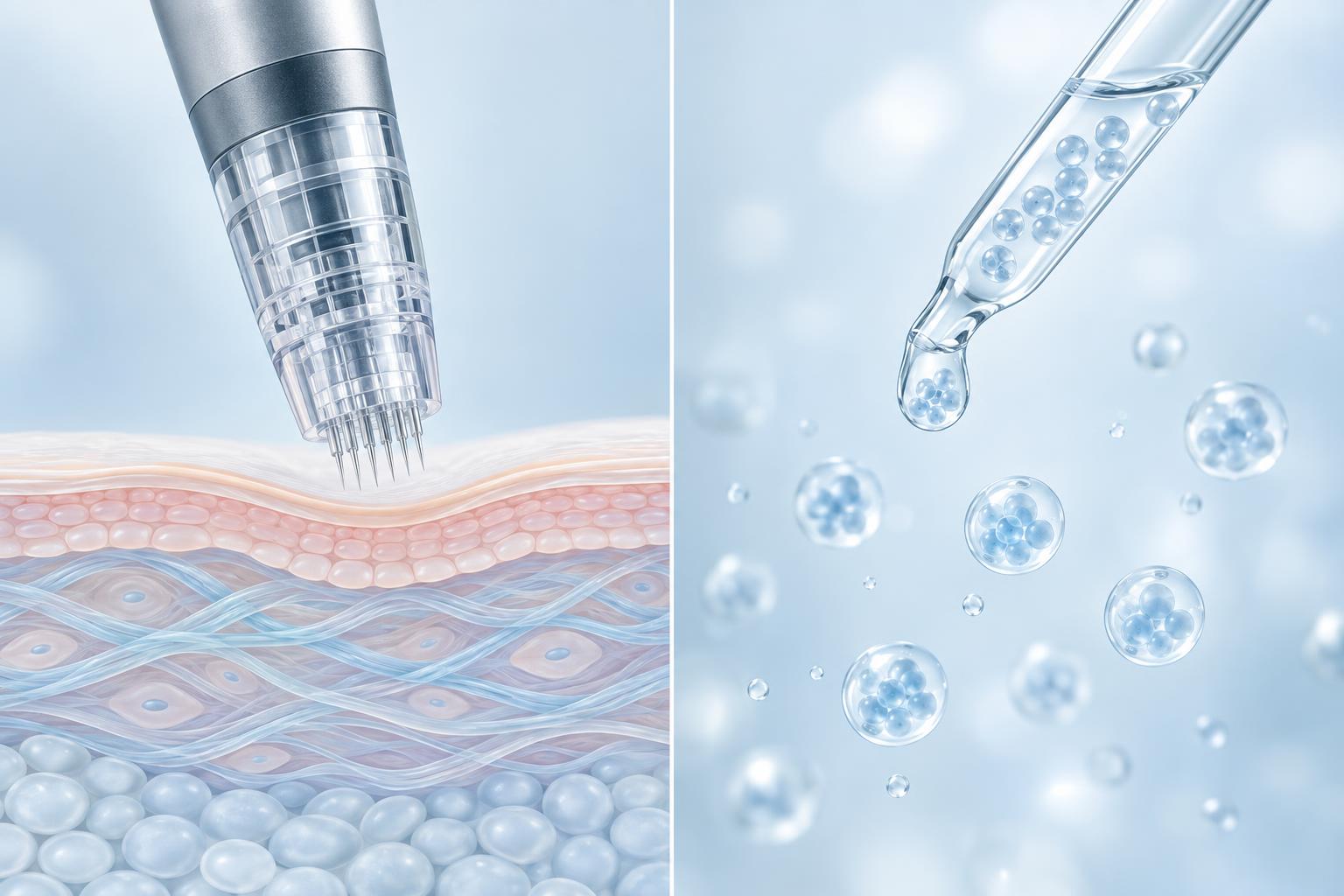
A treatment menu may list "radiofrequency microneedling with exosomes" as a single item. In practice it is at least two things: an energy-based device and a topical product applied with it. That distinction matters when you read claims about results. One registered facial study makes the point explicitly. Every participant received the same radiofrequency microneedling procedure, and the groups differed in the product used as a glide and afterwards at home. This guide uses that study and a second study, which used mechanical microneedling, to show how to separate device claims from adjunct claims. It does not judge whether any of these products work.
Why a combination treatment has more than one variable
A result reported after a combination protocol could come from the device, the topical, the aftercare routine, or the way they interact. A well-designed study picks which of these to vary and keeps the rest constant. In the radiofrequency study discussed below, every participant received one facial treatment with the EXION Fractional Radiofrequency device. The registration states that this procedure was common to both groups and was not the variable under investigation. Whatever that study eventually reports, it is not designed to show how the RF device performs on its own. It is a study of what was added on top.
Inside one registered radiofrequency microneedling study
In the active group, AnteAGE Biosome Treatment Solution was applied to the face as the topical glide during radiofrequency microneedling. Afterwards, these participants used a study-supplied skincare regimen of cleanser, moisturizer, sunscreen, AnteAGE Biosome Serum and AnteAGE Serum/Accelerator.
The control group received hyaluronic acid as the glide, then used a control cleanser, moisturizer, sunscreen and control homecare products. So two things change between the groups at once: the glide used during the procedure and the regimen used at home. Even a clear difference between the groups could not, by design, be credited to the treatment solution alone. It would reflect the active package as a whole.
The registered assessments were adverse reactions, standardized facial photography with a VISIA imaging system, participant and investigator assessments of facial skin, and Global Aesthetic Improvement Scale ratings. Follow-up visits were scheduled for Days 1, 3, 7, 30 and 60 after the treatment visit.
The registration lists the study as completed, with an enrollment of 30, and the registration details described here do not report outcome results. A completed status only means the study has ended. It says nothing about what was found.
A mechanical microneedling study is a different case
A second registered study sometimes comes up alongside the RF one, but it uses a different technology. Participants had mechanical facial microneedling with the Candela Exceed device three times, about four weeks apart. Topical AnteAGE Exosomes and PEARL Multiplier were applied during and/or immediately after each session.
This was an open-label, single-arm exploratory study with a standardized homecare regimen, and it lists an enrollment of 12. Without a comparison group, any change could come from the needling, the topicals, the homecare or simply the passage of time, and the design cannot tell these apart. Because the needling was mechanical, the study also tells readers nothing about radiofrequency device performance or settings.
What 'exosome' and 'extracellular vesicle' actually mean
In the scientific literature, extracellular vesicles (EVs) are particles enclosed by a lipid bilayer. Living cells release them, and they cannot replicate on their own. A published review of EVs in skin applications describes exosomes as one type of EV, defined by origin: they come from the cell's endosomal network, while other EVs are produced by different cellular processes.
That definition is about biological origin, not branding. The name "Exosomes" or "Biosome" on a product does not show which vesicles it contains, how many there are, or where they came from. The study descriptions summarized here do not say what these products contain, so readers should not work out their composition from the label.
Evidence to look for before crediting the adjunct
The same review analyzed 12 clinical studies of EVs in skin aging, acne scars, alopecia and wound healing. It saw potential for regenerative use, but it also identified major problems with standardizing production and a lack of large-scale randomized studies.
The review cites the MISEV2023 guidelines, which set minimum reporting requirements for EV nomenclature, sources, isolation methods, characterization and functional studies. It also discusses studies of products said to contain exosomes that were not included in its comparison. Those studies did not describe isolation methods, molecular markers or purity assessments, and in the review's view that gap makes it unreliable to attribute the observed effects directly to exosomal activity. The general lesson is that missing characterization weakens any claim that vesicles caused a result. The review also points out that differences in vesicle concentration, application frequency and treatment schedules make results hard to compare across studies.
That leads to a practical reading checklist. First, find out which component actually differed between groups, and whether the device was the same for everyone. Second, check whether aftercare differed too. Third, look for a comparison group and published results, not just a completed status. Fourth, see whether the product's vesicle source, isolation method, markers, purity, concentration and dosing schedule were reported. Finally, keep a manufacturer's description of a product separate from specifications that have been independently reported. If a claim cannot be traced to a specific variable and documented characterization, treat it as a claim rather than an established effect. This is general information, not medical advice. Treatment decisions belong in a conversation with a qualified clinician.
ClinicalTrials.gov aesthetic device protocols · Europe PMC open-access skin