Needle-Free Jet Injection for Atrophic Acne Scars: How the Delivery Mechanism Works and Which Device Details to Check
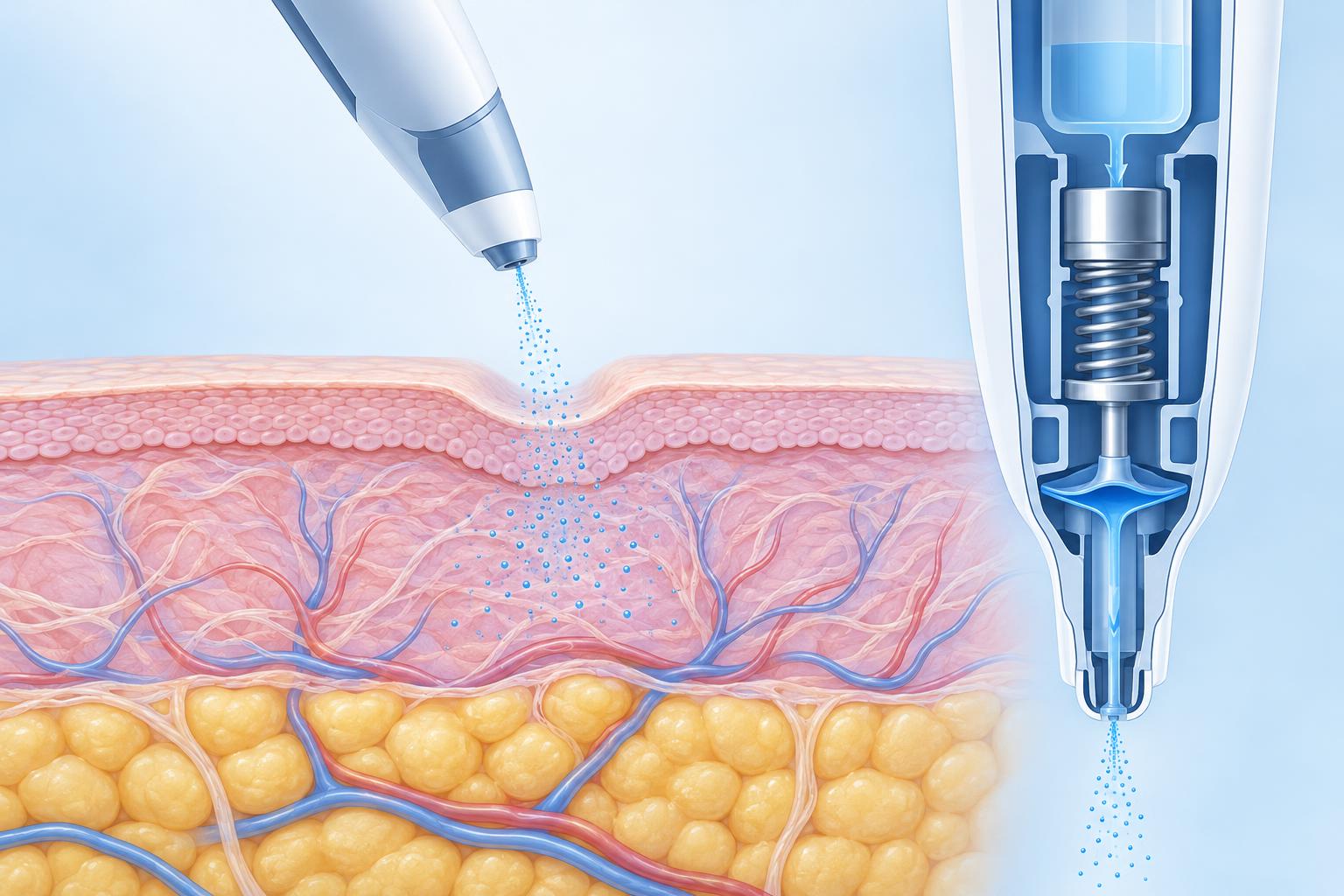
Filler for depressed scars has usually gone in through a needle, using many small punctures to place tiny amounts into the upper skin. A published case report describes a different approach. Three men with atrophic acne scars on their cheeks were treated with poly-lactic acid delivered by CUREJET, a needle-free electromagnetic jet injector. The report is useful because it lists concrete settings. It is also easy to misread, because three separate things get blurred together: how the device moves liquid, what settings were used in three patients, and what the injected material is supposed to do. This guide separates those layers.
From multiple needle punctures to a pressurized jet
In conventional intradermal filler work, a clinician uses a syringe and needle to place small amounts of product into the superficial dermis, one puncture at a time. Jet injection skips the needle. A burst of pressure forces liquid through a very narrow nozzle fast enough for it to enter the skin.
The review section of the report describes two ways to generate that pressure. Laser-powered injectors fire laser pulses that create vapor bubbles, and the bubble pressure pushes a jet out through the nozzle. Electromagnetic injectors, also called Lorentz force-driven injectors, use an electromechanical actuator to drive a piston that accelerates the liquid.
How an electromagnetic injector like CUREJET moves liquid
The authors describe CUREJET's sequence step by step. Electric current in the actuator coil creates an electromagnetic force that pushes a piston forward. The piston strikes a membrane, which passes its momentum to the liquid in the drug chamber, and the liquid leaves through the nozzle toward the target area.
The report says this cycle can repeat at up to 20 Hz. That is a stated maximum for the device. It is not the setting used in the cases, which ran at 3 Hz. When you read device descriptions, treat the upper limit and the settings actually used as separate numbers.
The device versus the material: what poly-lactic acid is supposed to do
The injector is only a way of delivering a substance. The substance in this report is poly-lactic acid (PLA). The article names two medical forms: poly-(L-lactic acid), or PLLA, and poly-(D,L-lactic acid), or PDLLA. The authors say PLA corrects the contours of depressed scars by stimulating new collagen production. That claim is about the material, not the jet mechanism.
Each patient had one treatment. The preparation combined 42.5 mg of PDLLA and 7.5 mg of non-cross-linked hyaluronic acid per vial, diluted with 8 mL of saline. Any result from these cases reflects this formulation and this dilution together. It does not show how the device would perform with other products.
Reading the reported settings: nozzle, frequency, energy, distance and per-shot volume
The case settings were a 150 μm nozzle, a frequency of 3 Hz, and energy level 5, which the authors equate to 200 volts. The nozzle was held 5 mm above each depressed scar, and each lesion received two or three consecutive shots.
The procedure description gives 1.5 microliters per shot, but the discussion clarifies that this is the manufacturer's figure for roughly how much liquid the device propels. The authors say they do not know exactly how much PLA actually reached the dermis and subcutaneous tissue. The 1.5 µL figure describes what the device is said to output, not a measured dose in the skin.
A preliminary test on cadaver skin found PLA particles after a single injection mostly in the upper and mid dermis, with a smaller amount in the lower dermis and fat. The authors warn that living skin may behave differently, especially because of the viscoelasticity of the dermis. So the cadaver pattern does not confirm how deep the product goes in patients.
What three cases can and cannot tell you
The patients were men aged 17, 31 and 34. They were assessed 8 to 12 weeks after treatment and followed for up to six months. All reported mild pain during the procedure, plus brief swelling, redness and petechiae. Two had fine crusts that cleared within days. The authors observed no product-related nodules or local inflammation during follow-up.
The authors reported improvement in the scars of all three patients two to three months after treatment. There was no comparison group, including no needle-delivered PLA. They also state directly that the accuracy advantage they claim for the needle-free injector remains unvalidated, and they call for larger, controlled studies to confirm safety and effectiveness. Three uncontrolled cases can suggest a direction for research. They cannot establish that the approach works, or that it beats needle injection.
A checklist for evaluating needle-free injector claims
The following questions are an editorial reading aid, not medical advice. First, ask whether a number is a device maximum, like the 20 Hz ceiling, or a setting actually used in a study. Second, ask whether a per-shot volume was measured in tissue or comes from the manufacturer. In this report it came from the manufacturer. Third, check whether depth data came from living skin or from cadaver tissue, which may behave differently. Fourth, look for a controlled comparison. Here the authors themselves say the accuracy claim is still unvalidated. Anyone considering a scar treatment should discuss it with a qualified clinician who can assess their individual case.
Europe PMC open-access skin