Fractional Radiofrequency vs Fractional Laser for Atrophic Acne Scars: How the Energy Delivery Differs
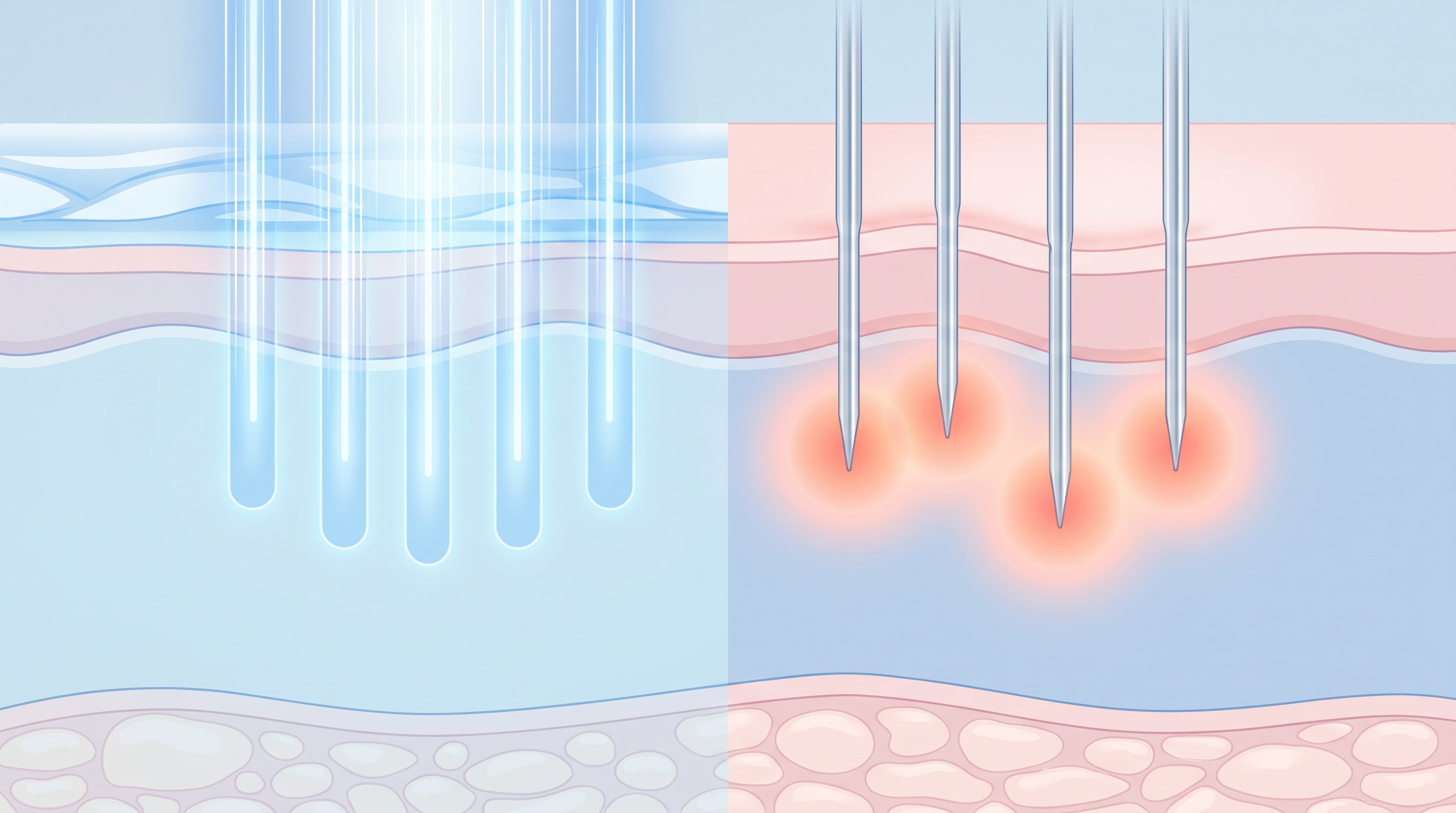
Put a fractional laser handpiece next to a radiofrequency microneedling tip and both appear to promise the same outcome: controlled injury that prompts scarred skin to rebuild collagen. The engineering behind them is quite different, though. A laser relies on light that a target in the tissue has to absorb. An RF microneedling system pushes insulated or non-insulated needles into the dermis and releases bipolar radiofrequency energy there, largely bypassing the surface. A retrospective study of 397 patients with atrophic acne scars recently put the two side by side, reporting outcomes, pain and complications for each group. This guide explains the mechanisms, the published settings and what that cohort does and does not establish.
Two ways to deliver heat into scarred skin
A fractional laser divides its beam into many microscopic columns. Researchers describe fractional lasers as producing controlled microthermal injury in the superficial dermis. Ablative types such as CO2 and Er:YAG also vaporize tissue, which drives new collagen formation and resurfacing of the skin. The energy has to be absorbed by a chromophore, meaning a light-absorbing target in the tissue, so the result depends on the interaction between the laser's optics and the skin.
Fractional radiofrequency needs no chromophore. Microneedles carry bipolar current directly into the dermis, where the tissue's resistance converts it into heat. The investigators behind the comparative cohort describe this as thermal damage placed deeper in the dermis while the epidermis is spared. In their view, that could mean less downtime and a lower risk of hyperpigmentation. They present this as an interpretation of the mechanism. It is not a tested guarantee.
Some lasers work differently again. Fractional picosecond lasers remodel the dermis mainly through laser-induced optical breakdown and photoacoustic effects, not photothermal ablation. That means a spec sheet listing "laser" can describe very different kinds of tissue interaction.
What published parameters actually look like
When RF microneedling settings do appear in the literature, they tend to be specific to the study and the part of the face treated. In one multimodal study that combined RF microneedling with fractional laser treatment, operators used 110 ms pulses at 15 W and 3.0 mm depth on scarred areas. The periocular region got a gentler 80 ms, 10 W and 1.5 mm. These numbers show how one team adjusted its protocol. They are not a universal standard.
Many of the hardware details that engineers care about are missing from the published record. The comparative acne scar cohort did not report the RF generator's operating frequency or pulse shape. Neither dataset gave tissue impedance values. When marketing materials quote such figures, they are manufacturer statements that this evidence does not verify.
Inside the 397-patient comparative cohort
The study looked back at 397 patients with atrophic acne scars. Of these, 254 were treated with fractional laser and 143 with fractional radiofrequency. The researchers used propensity score stratification to balance baseline characteristics between the groups. That reduces some confounding, but a retrospective design cannot match a randomized trial.
At six months, 88.1% of RF-treated patients and 71.9% of laser-treated patients reached the primary endpoint of at least 25% scar improvement. The statistical conclusion is more modest than those numbers suggest. Using a 20% margin, fractional laser met the criterion for non-inferiority to fractional radiofrequency, but the two could not be declared equivalent. So the study does not prove that either modality is better, and it does not prove they perform the same.
The authors' background review cites earlier reports of 51% to 70% clinical improvement with ablative fractional lasers for moderate-to-severe atrophic scars. Those figures come from separate studies that used their own measures. They should not be read as directly comparable to this cohort's endpoint.
Pain, pigmentation and other adverse events
The clearest difference was pain. Patients treated with fractional radiofrequency reported average scores of 5.65, against 4.14 for fractional laser, and this difference was statistically significant.
Complication rates were lower. Post-inflammatory hyperpigmentation occurred in 5.42% of laser patients and 4.71% of RF patients. Acneiform eruptions occurred in 6.67% and 3.53% respectively. None of these differences reached statistical significance, so the cohort does not show that either method produces fewer complications.
The wider literature notes that ablative fractional lasers can cause erythema, discomfort, long recovery and hyperpigmentation, especially in Asian skin. A separate cohort of 324 patients treated with microneedling, RF microneedling or ablative CO2 laser, each followed by topical chitosan, recorded two early folliculitis or pustular events (0.62%). That study had a different design and population, so its figures should not be combined with the comparative cohort's.
Reading device claims against the evidence
When a brochure calls RF microneedling suitable for every skin type, that draws on the chromophore-independence argument. The underlying source makes the same case. But one retrospective cohort's pigmentation figures, which showed no significant difference, cannot confirm a universal safety claim. Likewise, the higher RF responder rate should be read alongside the formal result: laser met the non-inferiority test, and equivalence was not shown.
When comparing systems, it helps to separate claims into three kinds: verified specifications, study-specific settings, and marketing language. Published settings such as pulse duration, power and depth describe what one team did in one protocol. Whether either modality, or any particular setting, suits a given person's scars and skin is a decision for a qualified clinician after an in-person assessment.
Europe PMC open-access skin