Fractional CO2 Laser vs. Microneedling Systems for Atrophic Acne Scars: Mechanisms, Specifications and Trial Evidence
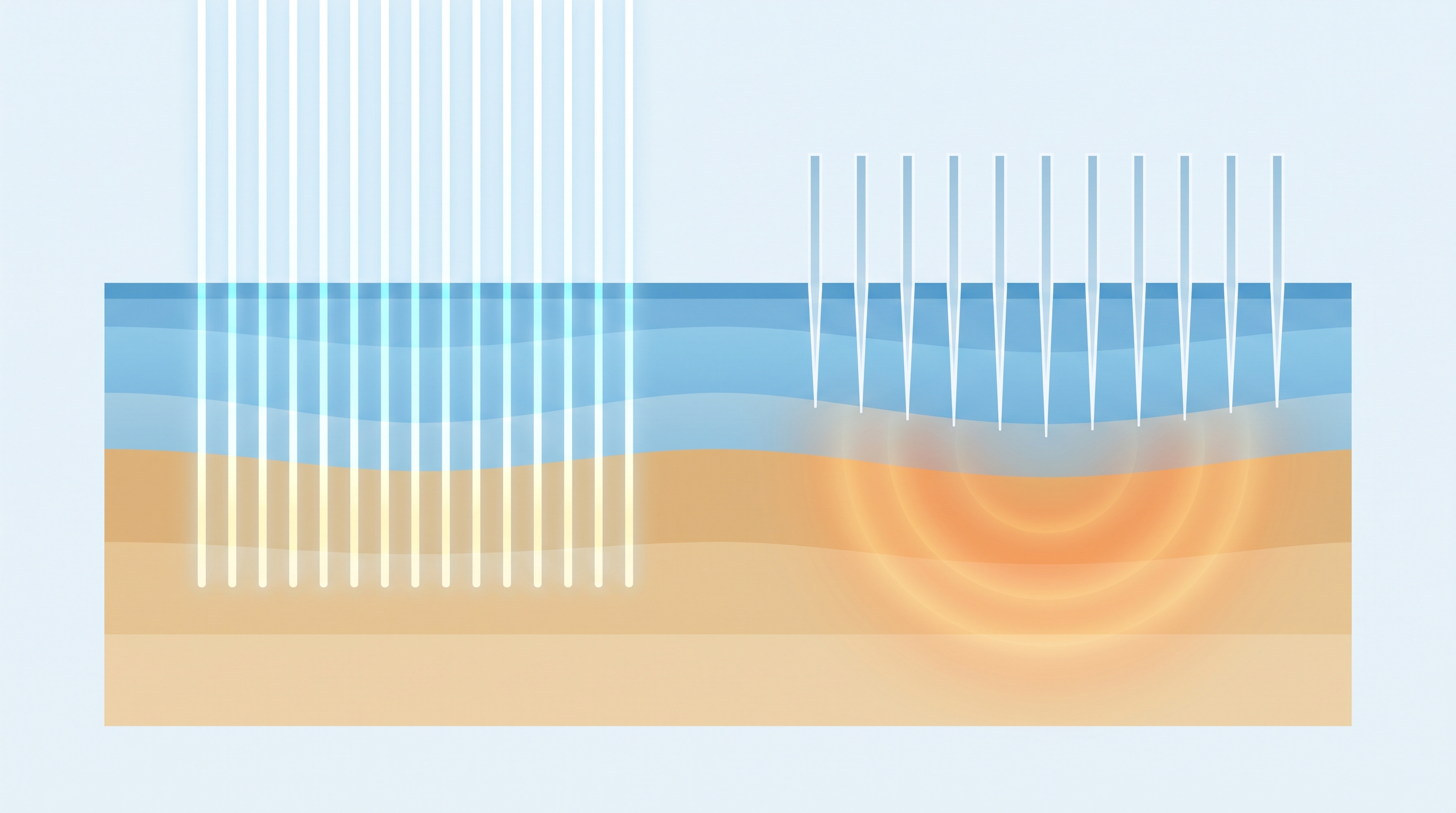
Device catalogues tend to list "fractional laser" and "microneedling" side by side, as if they were two settings on the same dial. Mechanically they are not related at all. One vaporises microscopic columns of epidermis and dermis with absorbed light; the other punctures the skin with fine needles, and in its radiofrequency variant heats the dermis while leaving the epidermal surface intact. A systematic review and meta-analysis pooling 17 clinical trials published between 2017 and 2025, covering 1,068 patients, attaches numbers to a comparison that device literature usually frames qualitatively. Reading those numbers well means keeping the mechanism and the statistics separate.
Two different ways to injure skin on purpose
Fractional CO2 laser resurfacing works by ablating columns of epidermis and dermis, leaving untreated tissue between them, with the goal of inducing new collagen production. Ablative fractional devices create what the literature calls micro-therapeutic zones through controlled ablation; those microscopic thermal injuries initiate wound-repair processes including inflammatory cell infiltration and the release of associated growth factors. The injury is optical and thermal, and the epidermal barrier is deliberately breached.
Needle-based systems start from a different premise. Microneedling generates controlled micro-injuries mechanically, and when combined with radiofrequency it delivers heat into the dermis without harming the epidermis. That distinction has a close optical analogue: non-ablative fractional lasers induce controlled dermal thermal damage through precise photothermal effects without disrupting the epidermis, a process reported to stimulate fibroblast activity and the synthesis of collagen and elastin. Whether the epidermis is sacrificed is the single clearest dividing line between these device families.
The wavelength specifications behind the phrase "fractional laser"
"Fractional laser" is a delivery pattern, not a specification. In acne scarring, ablative fractional platforms operate at 2,940 nm and 10,600 nm, while non-ablative fractional devices use wavelengths including 1,440 nm, 1,540 nm and 1,550 nm. Those numbers correspond to different absorption behaviour in tissue, so two machines carrying the same marketing label can produce very different depths and patterns of injury.
The split matters even within the ablative group. A 2024 meta-analysis reported that CO2 lasers had a significantly higher effective rate and a shorter recovery period than Er:YAG lasers, while also being associated with greater intraoperative pain and a longer duration of postoperative erythema. A comparison that names only the category, rather than the wavelength and parameters, is not comparing like with like.
What a needling protocol actually specifies
On the needling side, the meaningful specifications are penetration depth and treatment interval. One randomized clinical study of facial atrophic acne scars documents the format concretely: a Dermapen device applied after topical anesthetic and skin cleansing, at a needle penetration depth of 1.5 mm, repeated at two-week intervals. The trial, run at Kafrelsheikh University Hospitals, allocated 60 adults equally to microneedling alone, microneedling followed by 35% glycolic acid peeling, or microneedling followed by 15% trichloroacetic acid peeling.
Radiofrequency microneedling adds a second variable that a mechanical device does not have — the energy deposited at the needle tips, which delivers heat to the dermis without harming the epidermis. Depth alone therefore does not describe an RF protocol, and results from mechanical and RF needling should not be read as interchangeable.
Pooled efficacy: where the approaches did and did not separate
The pooled analysis drew on 1,068 patients across 17 studies, under a protocol retrospectively registered with PROSPERO in November 2025. For the primary efficacy outcome, mean scar score reduction, the comparison between fractional CO2 laser and microneedling was non-significant (SMD −1.08, 95% CI −2.48 to 0.32), with heterogeneity of 97%. Mean quantitative scar reduction against RF microneedling was likewise non-significant (SMD 0.12, 95% CI −0.80 to 1.04, I² = 92%).
One outcome did reach significance. Categorical treatment success favoured fractional CO2 laser over RF microneedling (RR 1.10, 95% CI 1.01 to 1.20), and here heterogeneity was zero. A confidence interval that only just clears 1.0 describes a narrow margin on a binary success definition; it is not a statement about how much scar depth changed, which is what the continuous outcomes above failed to resolve.
How fragile those pooled numbers are
Heterogeneity above 90% means the included trials were not measuring a single consistent effect, and the sensitivity analysis demonstrates the consequence. After excluding one influential study, the pooled result for quantitative scar reduction reversed direction and became statistically significant in favour of RF microneedling (SMD −0.26, 95% CI −0.59 to −0.08, p < 0.05), with heterogeneity dropping to 0%. A pooled estimate that flips when a single trial is removed is a statistical artefact of the evidence base, not a clinical verdict.
The same fragility appears in safety outcomes. For crusting and scabbing, the relative risk was high at 12.08, but the pooled result was not statistically significant (95% CI 0.60 to 243.67, p = 0.10) with heterogeneity of 77%. An interval spanning three orders of magnitude carries almost no information.
Tolerability signals: pigmentation, pain and downtime
Pigmentation is where the comparison produced its clearest safety signal. Fractional CO2 laser showed a significantly higher risk of post-inflammatory hyperpigmentation than standard microneedling (RR 3.04, 95% CI 1.49 to 6.21, I² = 3%). Against RF microneedling, however, the same comparison did not reach significance (RR 2.45, 95% CI 0.77 to 7.80, p = 0.13, I² = 0%), based on four trials and 202 participants — a non-significant result here reflects few events, not demonstrated equivalence.
Pain ran in the opposite direction from what the ablative mechanism might suggest. Pooled pain scores were significantly lower for fractional CO2 laser than for RF microneedling (SMD −0.74, 95% CI −1.27 to −0.21, I² = 0%). A large propensity-score cohort reported the same pattern, with mean pain scores of 5.65 ± 1.74 for fractional radiofrequency versus 4.14 ± 1.83 for fractional lasers (P < 0.001).
No significant differences emerged for erythema, crusting or scabbing, or edema. Single-study figures should stay anchored to their setting: treatment of atrophic acne scars in Asian patients with a 2,940-nm ablative fractional erbium laser produced mild post-inflammatory hyperpigmentation in 30% of patients — a result tied to that wavelength, that protocol and that population rather than to energy-based devices generally. Taken together, the evidence currently distinguishes these platforms more reliably by mechanism and tolerability profile than by pooled efficacy, which remains too heterogeneous to settle. Any individual treatment decision belongs with a qualified clinician assessing skin type and scar morphology.
ClinicalTrials.gov aesthetic device protocols · Europe PMC open-access skin