1550 nm Non-Ablative Resurfacing With Focal Point Technology: Specs, Skin-Type Data and Post-Laser Recovery
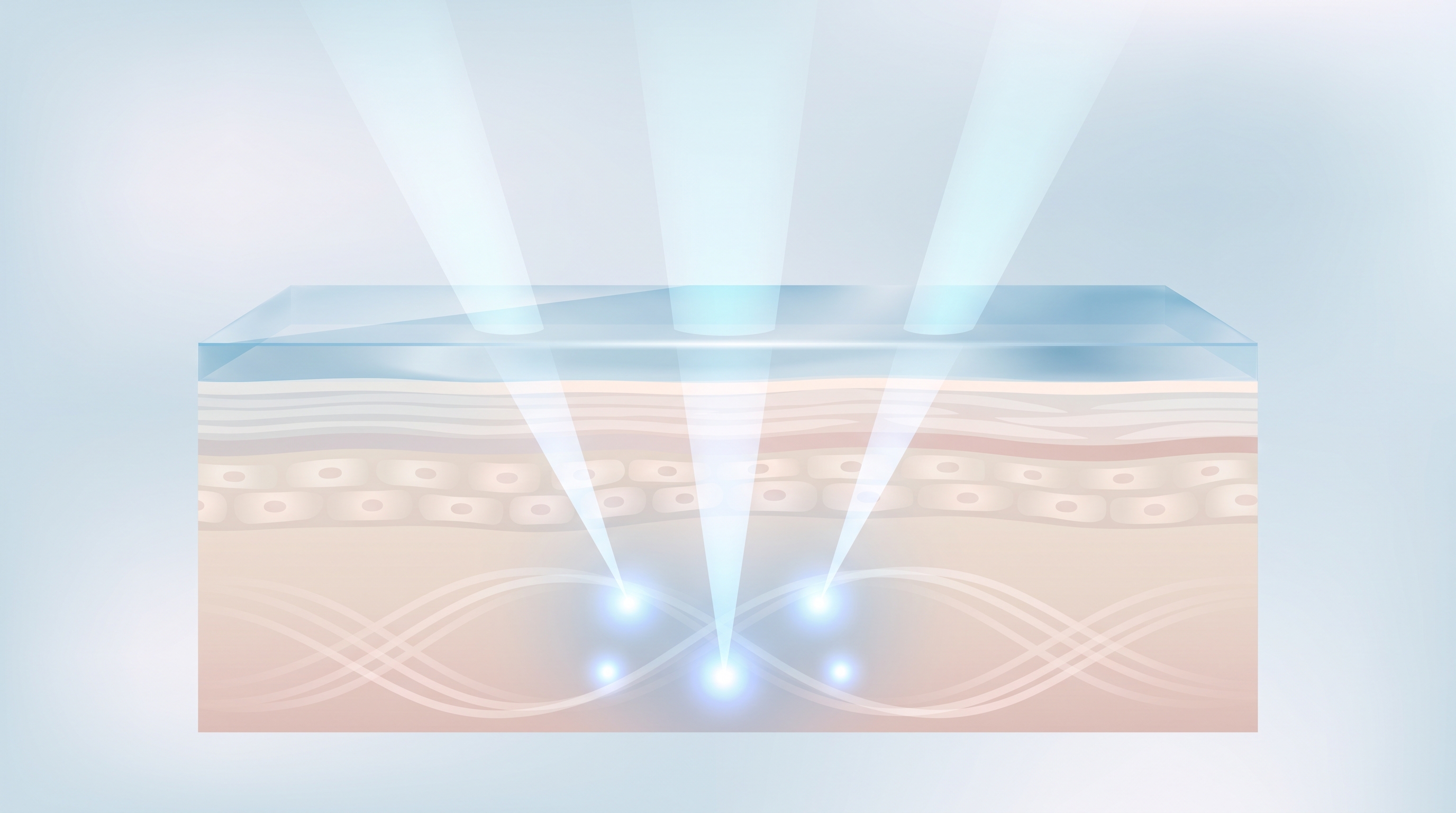
For years, 1550 nm non-ablative resurfacing lasers were limited to pulse energies of up to 70 mJ. A newer generation built around what its developers call Focal Point Technology is described as delivering up to 150 mJ. That is a big jump, and it raises two practical questions: how does the extra energy reach the dermis without overheating the surface, and what happened when the approach was tested on a range of skin types? This article sets the device parameters reported in one published trial apart from its clinical outcomes. It then looks at a separate study of a hyaluronic acid hydrator applied right after laser treatment. Each study stands on its own, and the two were never tested together.
What changes with focal point optics in a 1550 nm laser
The main idea is geometry. Focal point optics send the beam in as a cone. Energy is spread over a wider area near the surface and concentrated at the target depth. Because the superficial layers see a lower energy density, the study authors report that pulses of up to 150 mJ can be delivered through the skin, compared with up to 70 mJ for traditional 1550 nm non-ablative systems.
Treat that ceiling as a figure reported by the researchers for this design. It is not a universal performance guarantee. A higher maximum energy describes what the hardware can deliver. On its own, it says nothing about outcomes for any particular patient.
Cooling and coupling: protecting the epidermis during high-energy passes
Two features in the study protocol were aimed at protecting the skin surface. First, the handpiece has a built-in sapphire contact window that can cool to as low as -10°C. The authors describe this as essential for surface protection and comfort at high energies. Second, a thin layer of bland hydrogel was applied to the face before treatment. It helped couple the laser energy into the skin, let the handpiece glide smoothly and spread the cooling evenly across the epidermis.
Two treatment depths and the energy used at each
The protocol treated up to two skin layers. The deeper pass produced coagulation zones 700–1300 μm deep with significant epidermal sparing, using pulse energies of 50–150 mJ. The superficial pass produced zones 200–400 μm deep with less epidermal sparing, using 20–30 mJ.
Later in the study, some sessions treated both layers at once. In those sessions, the mean energy delivered was 3.867 kJ for the deeper layer and 1.952 kJ for the superficial layer, for a combined mean of 5.819 kJ. These are averages from one protocol, not recommended settings.
What one trial reported across Fitzpatrick skin types I–VI
The prospective trial enrolled 47 patients spanning Fitzpatrick skin types I through VI. On the Global Aesthetic Improvement Scale, 78.0% of subjects were rated improved or much improved, and none were rated as worse. The only pain control was topical anesthetic applied for up to 60 minutes. With that, the mean pain score during treatment was 4.4 out of 10.
When the researchers compared skin types I–III with IV–VI, they found no statistically significant differences in blinded evaluations, ECCA scores or adverse event rates. That finding is encouraging, but it has limits. It comes from one modest-sized study. A difference that is not statistically significant is not proof that outcomes are equivalent. Larger or independent studies could still reveal differences that this sample was too small to detect.
Post-laser topical care: what the hyaluronic acid hydrator study measured
A separate study looked at a hydrator containing five forms of hyaluronic acid (HA): time-release, cross-linked, liposomally encapsulated, non-cross-linked and nano-HA. The hydrator was applied immediately after laser treatment. Right after application, investigators recorded a mean 31.1% decrease in dryness and scaling and a mean 19.3% increase in radiance.
By day 2, investigators reported a 44.4% mean decrease in redness and a 28.1% mean increase in radiance, both compared with assessments taken after the laser but before the hydrator. Burning and stinging scores fell from a mean of 1.2 to 0.6 on application and reached 0 by day 2. The data stop at day 2. They describe one product in one study, not a general recommendation or evidence of longer-term recovery.
Reading these numbers carefully
The 150 mJ versus 70 mJ comparison and the depth and cooling figures above are specifications reported in a study, not independently verified benchmarks. The 78.0% improvement rate and the skin-type comparison each come from a single 47-patient trial. The hydrator results come from a different study of one formulation. Keeping these sources apart is the most useful way to read them. Anyone considering a 1550 nm procedure, or deciding what to apply afterward, should make those decisions with a qualified clinician who can take their own skin and history into account.
Europe PMC open-access skin